

How to choose garden furniture covers
of reading
A table covered in pollen in spring, damp cushions after a summer storm, garden furniture dulled by the sun: the outdoors puts furniture to the test. To know how to choose a garden furniture cover, you need to look at much more than just the color or the price. A suitable cover truly protects your equipment, limits cleaning, and prevents you from replacing a table, chairs, or an outdoor sofa that are still in good condition too soon.
The right choice depends primarily on what you want to cover, the available space, and the weather conditions in your region. A cover that's too large will blow away or retain water. A cover that's too tight will tear more quickly and can leave exposed areas. Here are the simple criteria to check before protecting your patio, deck, or balcony.
Start by identifying the furniture to protect
A garden furniture cover must match the actual shape of your setup. This seems obvious, but a large universal cover placed over a set of chairs may be less effective than a cover designed for each individual item. Water can accumulate in hollows, the wind can lift the fabric, and moisture can remain trapped under the protection.
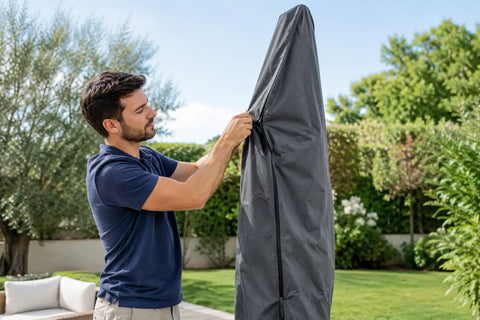
For a rectangular table with its chairs, choose a cover long enough to cover the entire set down to the legs. This is a practical solution if you leave your dining area assembled throughout the season. For a round table, a slightly ample round or square cover will better fit the volume. Armchairs, stacking chairs, sun loungers, parasols, barbecues, and outdoor sofas require specific formats.
If your furniture has high armrests, a reclining backrest, or a table with a parasol hole, don't rely solely on the number of seats. Measure the bulkiest piece of furniture. A cover should cover exposed parts without being stretched like a tarp.
How to choose a garden furniture cover in the right size
Always measure the width, depth, and height before ordering. Use a tape measure and note the dimensions in inches or centimeters according to the product specifications. In the United States, dimensions are often given in inches: 1 inch is equivalent to 2.54 cm. This check helps avoid errors at the time of purchase.
For a table and chairs, measure the set once the chairs are put away in their usual place. For an outdoor sofa, measure the maximum depth, including armrests. For stacked chairs, measure the entire stack, not just one chair.
Allow a small margin, generally 1 to 3 inches, so that you can easily install and remove the cover. However, avoid too large a margin. Excess fabric creates pockets where rainwater can stagnate and increases wind resistance. If you're hesitating between two sizes, also look at the tightening systems: a slightly larger cover with a drawstring or straps may be a better choice than a model that's too snug.
Check the height to the ground
A cover that extends almost to the ground better protects furniture legs from splashes, dust, and leaves. But it doesn't necessarily have to touch the ground all around. A slight gap promotes air circulation and limits condensation, especially in humid regions or during large temperature fluctuations.
This detail is particularly important for wooden furniture, synthetic rattan, or furniture with cushions stored underneath. The goal is to protect from rain, not to create a constantly humid environment.
Choose a material suitable for your weather
Not all covers meet the same needs. A very sunny Florida patio, a patio exposed to Northeastern rains, or a garden subject to wind and temperature variations do not require the same level of protection.
Polyester is appreciated for its good balance of lightness, resistance, and easy maintenance. It is suitable for regular use and is easy to handle. When treated with a water-repellent finish, it helps water slide off rather than penetrate the fabric. It's a good choice for covering furniture between uses or during rainy periods.
A thicker fabric, often with a protective coating, will be preferable if your furniture stays outdoors all winter. It resists repeated bad weather, plant debris, and friction-related wear better. On the other hand, it can be heavier to fold and take longer to dry after heavy rain.
UV protection also deserves your attention. The sun doesn't just damage cushions: it can discolor wood, weaken certain plastics, and dull finishes. A UV-treated cover is particularly useful when garden furniture remains exposed for several hours a day, without a pergola or tree to cover it.
Water-repellent, waterproof, or breathable: what's the difference?
A water-repellent cover repels water from the surface. It is very practical for short rains and daily humidity. A waterproof cover offers a stronger barrier against rain, but it should ideally incorporate vents or breathable fabric. Without air circulation, condensation can promote odors, damp stains, or mold.
The best compromise is often a water-resistant cover with vents or ventilation panels. It keeps furniture dry while allowing residual moisture to escape. If you live in a very dry area, breathability will be less critical than protection against dust and UV rays. In a rainy region or near the coast, it becomes a real criterion for comfort and durability.
Don't neglect wind fasteners
A cover placed on furniture is not always enough. In a gust of wind, it can act like a sail, move, and leave your furniture exposed. Fasteners therefore make a big difference, especially for open terraces, balconies, and unprotected gardens.
A drawstring allows you to adjust the cover around the base of the furniture. Buckle or clip straps often attach to the legs and provide a firmer hold. Elastic bands are simple to use, but they can be less effective against strong gusts on large furniture.
For a low sofa or a large table, opt for adjustable straps. For stacked chairs or a small armchair, an elasticated hem may suffice if the location is sheltered. Also check the strength of the seams: they are what withstand the tension when the cover is tightened or buffeted by the wind.
Think about actual use, not just winter
Many people only buy a cover for the bad season. However, it is useful all year round. In spring, it protects against pollen and unpredictable rains. In summer, it reduces the accumulation of dust, leaves, bird droppings, and UV rays. In autumn, it prevents moisture and debris from settling in the corners of the furniture.
If you use your garden furniture every day, choose a cover that is easy to put on and store. A heavy, very protective model is ideal for long winter storage, but can become cumbersome for daily use. Conversely, a lightweight cover is quick to handle, while offering practical protection between meals or during a weekend away.
Also keep in mind that the cover does not replace maintenance. Before covering furniture for several weeks, remove crumbs, leaves, and stagnant water. Let surfaces dry as much as possible. For cushions, it is often better to store them indoors or in a specially designed storage box, even under a protective cover.
The details that really make life easier
A handle is useful for removing a large cover without pulling on the seams. A cover supplied with a storage bag is easier to keep clean when not in use. Protected vents prevent water from entering while improving air circulation. These small details are not secondary: they often determine whether you will use your cover regularly.
Color can also play a role. A dark shade better hides dust and marks, while a light cover generally heats up less in the sun. The choice depends on your exposure and the appearance you want to maintain on your patio. The essential elements remain a resistant material, correct dimensions, and reliable fastening.
At 1001 Housses, the idea is simple: a good cover protects furniture without complicating your daily life. Take your measurements, observe the exposure of your outdoor space, and choose a model that you will want to install after each use. Your garden furniture will remain ready to welcome sunny days, rather than requiring a big clean every time.