

How to protect your bike from theft?
of reading

Statistics on stolen bikes are alarming in many parts of the world. For example, in Paris, nearly 500 bikes are stolen each month, which is 6,000 bikes per year in the capital alone.
Meanwhile, the number of bike thefts worldwide each year is between 1.5 and 3 million. A large proportion of bicycle thefts go unreported and remain unsolved.
Fortunately, there are many things you can do to protect your bike. Read these 10 tips to protect your bike and put them into practice as soon as possible. This will ensure that your two-wheeler remains in your possession forever.
1. Buy a bike lock

Very often, the security of your bike depends solely on your lock. Be careful, securing your bike with a good lock does not mean it won't be stolen.
With the right tools, thieves can get through practically any bike lock. All you can do is make it harder, more irritating, and longer for them.

Here's how:
Avoid cable locks, as most of them can be cut with garden shears. U-locks (see photo) and heavy-duty chains offer better bike protection, but are not impenetrable.
Never lock only the frame – otherwise, anyone with a tool can remove both wheels in less than a minute.
For additional bicycle protection, use two U-locks, one securing the rear part of the frame and the wheel, and the other locking the front.
- Your second lock can also be of a different type – so the thief will need a different set of tools to open it.
- Buy the smallest U-locks, as they give the thief less space to leverage the bike.
2. Never park in isolated places

Here's a paradox: a deserted, isolated place is just as dangerous for your bike as a crowded place.
This is partly due to the bystander effect – a phenomenon in social psychology where individuals are less likely to intervene or seek help for others when other people are present. Thieves go unnoticed in a crowd.
The solution is simple: park your bike in a well-exposed place, where passers-by can easily see it. Ideally, choose a spot under a security camera.
3. Register your bike

We all drive cars with license plates, but only some of us register our bikes. Yet, bike registration is a simple and inexpensive protection that increases the chances of recovering your bike if it is stolen.
Truly, there's no reason why you shouldn't take this extra precaution.
To register your bike, search online to find the authority responsible for this procedure in your city or region (it could be the municipality, the road traffic authority, or an independent program).

For registration, you will need to provide the manufacturer and model of your bike, as well as a unique serial number located on your bike's frame.
If, unfortunately, your bike is stolen, the unique code will allow the police to trace it back to you. Some bike registration programs also offer warning stickers to secure your bike, which reduce the risk of theft by alerting thieves that your two-wheeler is registered.
4. Bring your bike indoors

Whenever you can, bring your bike indoors to protect it. This applies to your daily commutes and especially when you return home and park your bike for the night.
If your bike companion is dear to you, don't leave it exposed in common areas or in your outdoor space, bring it inside! If you're afraid it will take up too much space in your home or bring in dirt, don't be!
There are countless bike storage solutions, suitable for all sizes and types of living spaces, and many of them are not only very practical but also very beautiful.
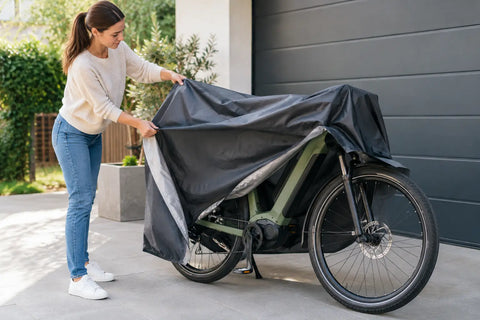
Plus, you can protect or dress up your bike with our bike cover collection! Add a little extra decorative touch to your interior, with unique colors and designs.
5. Bike GPS tracker

If you're a true cycling enthusiast, your bike is one of your most valuable possessions. You probably already have a bike lock and know the basics of smart bike parking.
But what if you're still not entirely reassured about the security of your two-wheeled companion and wonder what else you can do to protect your bike? Get a GPS tracker!

The product looks like a standard bike component - a bike light, buttons,... You can configure the tracker to alert you as soon as your bike moves, so you always know where it is.
You can also invest in a bike alarm that detects impacts on the bike, triggers a signal, and sends a message to your smartphone.
6. Make your bike less attractive/appealing

This probably sounds counterintuitive to most cyclists. Yes, you love your bike, and of course, you want it to look as good as possible. But that most likely means a thief will love it too and prefer it over other bikes parked nearby.
If you have to leave your bike locked in a public place, don't make it look too perfect and shiny. Some dirt or tape can make it less attractive to thieves.
To protect your bike, put tape on the seat post, handlebars, and various spots on the frame to make your bike look worn and shabby.

You can also put funny stickers on your bike frame. Not only will they make your bike appear less valuable, but they will also make it harder for the thief to get away unnoticed.
Some people say that having an old, cheap bike is the best way to protect it from theft. That's true, but you still need to make it difficult enough for a thief to get away with your bike. So never forget the other bike protection tips.
7. Don't park your bike in the same spot every day

If you park your bike in the same public place, you might experience a misleading sense of comfort – nothing has happened there before, right?
In reality, you're making it easier for criminals: they can pinpoint your bike's location and the times when no one is watching it, and plan a flawless attack.

Did you know that "professional" bike thieves often work in teams of three?
The first checks the bikes in a rack and chooses the most attractive and/or accessible one, and determines the necessary tools.
The second brings the tools and frees the bike, but doesn't take it.
- The third simply rides away with the bike – notice that none of them aroused serious suspicion individually.
Parking your bike in the same spot every day can attract unwanted attention.
8. Insure your bike

Unlike car insurance, bike insurance is not mandatory. But, if your bike is expensive, it's a small price to pay for the comforting feeling of security, and your bike protection will be enhanced.
Depending on your type of insurance, it can serve not only as a safety net in case of theft, but also as assistance in case of a traffic accident.

Remember that your insurer will most likely require reasonable precautions, such as locking your bike to a fixed bike rack or barrier.
Similarly, lending your two-wheeler to a friend or family member can be problematic if you are the only user mentioned in your policy.
If you're worried about leaving your bike in your building, on your terrace, or on your balcony, check if your homeowner's or renter's insurance covers bicycles. Be aware that many insurers only cover bikes if they are stolen from your home or a locked garage.
BETTER SAFE THAN SORRY

When it comes to protecting a bike, you can never do too much. Remember that even the best lock can eventually be picked by a determined crook.
So be sure to follow these bike protection tips to minimize the risk of your bike being stolen or snatched.
The secret sauce might be to combine several precautions to secure your bike in addition to registration and purchasing insurance.