

Outdoor Washing Machine Cover Guide
of reading
A washing machine installed on a covered terrace, in an open garage, or near an outbuilding remains practical for everyday use. But without good outdoor washing machine protection, it also receives dust, humidity, UV rays, pollen, and sometimes wind-driven rain. A suitable cover limits fouling and helps preserve the appliance's appearance, its controls, and its metal parts.
The right choice isn't to just grab the first tarp available. A cover that's too small pulls at the corners, a fully waterproof but unventilated cover can trap condensation, and a poorly secured model can blow away in the first gust of wind. Here's how to protect your washing machine simply, durably, and appropriately for its location.
Why cover an outdoor washing machine?
Even under an awning, an outdoor machine is more exposed than an appliance installed in a laundry room. Dust settles in the seals and around the detergent dispenser. The sun can dull the plastic of the control panel. Humidity, meanwhile, promotes the oxidation of screws, hinges, and certain metal parts.
The protective cover does not replace a secure electrical installation or an enclosed shelter. However, it provides a useful barrier between the machine and daily aggressions. In particular, it prevents having to wipe down the appliance before each wash and reduces dirt that eventually infiltrates into nooks and crannies.
This is particularly useful if your machine is located in a carport, on a covered balcony, in a pool house, or in a garage whose door often remains open. In these spaces, the appliance is protected from some bad weather, but not from humid air, splashes, and dust.
Outdoor washing machine protection guide: start with the location
Before choosing a cover, observe what your machine actually experiences. A washer under a deep roof doesn't have the same needs as a machine exposed to the Florida sun, the rain of the Northwest, or the snow of a Midwest winter.
If the appliance is only exposed to dust and occasional splashes, a flexible, water-repellent, and easy-to-remove cover is often sufficient. On the other hand, a machine placed near a very damp wall or in a windy area requires a more comprehensive cover, with a reliable tightening system.
Pay attention to an essential point: a washing machine should never operate when covered. Completely remove the cover before starting a cycle, then only replace it when the appliance is cold, dry, and not in use. Also ensure that plugs, cables, and water connections are protected in accordance with your home's safety regulations. If in doubt about an outdoor installation, have it checked by a qualified professional.
Measure the machine before ordering a cover
Dimensions are the primary criterion for effective protection. Measure the width, depth, and height of your machine, including any protruding elements: handles, visible hoses, prominent buttons, or the lid.
For a front-loading machine, measure from the floor to the highest point of the top panel. For a top-loading model, allow enough clearance to cover the lid without compressing it. If the water inlets are at the back and remain visible, decide whether you want to cover them or leave an accessible opening.
Add approximately 1 to 2 inches (3 to 5 cm) to your measurements. This margin allows the cover to be put on easily and prevents stress on the seams. Don't add too much width either: a very loose cover creates folds where water and dust can accumulate, while also catching more wind.
A cover that goes almost to the ground is generally a good choice. It protects the sides and limits splashes, without dragging in a puddle. If your floor is often wet, leave a small margin at the bottom of the cover to promote air circulation.
What material to choose for an outdoor cover?
For outdoor use, choose a cover designed to withstand humidity and dirt. Polyester with water-repellent treatment is appreciated for its easy maintenance and light weight. It is well suited for a sheltered machine, used regularly, and exposed to moderate conditions.
A thicker material offers more resistance to wind, rain, and UV rays. This is an interesting option for an appliance that is rarely used or installed in a very exposed area. The compromise is simple: the denser the fabric, the heavier the cover can be and the longer it can take to dry after heavy rain.
Waterproofness is useful, but breathability is just as important. A cover that traps all humidity can create condensation, especially after a hot day followed by a cool night. Therefore, look for a cut that doesn't hermetically seal the appliance and, when possible, discreet ventilation areas.
The inner lining also has its advantages. A soft lining reduces the risk of rubbing on painted surfaces or the control panel. It is particularly valuable if you remove and replace the cover very often.
The details that make a real difference
An outdoor washing machine cover must stay in place without becoming bothersome to use. Drawstrings, adjustable straps, or elastic at the bottom of the cover are useful in windy regions. They allow you to adjust the fit without crushing the machine.
A zipper or a flap on the front can be practical if you want quick access to the control panel without removing the entire cover. This depends on your usage: for a machine used several times a week, an easy-to-slip-on cover will often be more comfortable. For a machine used seasonally, a full, more encompassing cover provides greater peace of mind.
Also choose a color appropriate for the location. Dark shades better hide dust marks, but they can heat up more in the sun. Light tones reflect heat better, even if they show marks more easily. On a very sunny terrace, this difference can matter.
Install the cover without trapping humidity
Start by cleaning and drying the surface of the machine. Focus on the top, the seals, the detergent dispenser, and the areas around the door or lid. Covering an appliance that is still damp only keeps that humidity in contact with the materials.
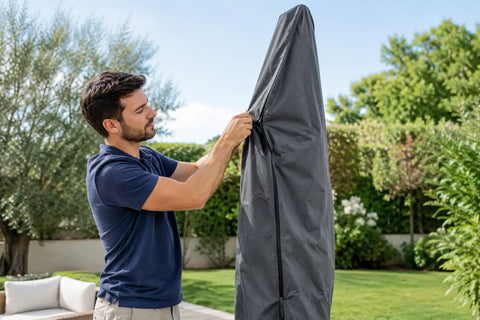
Then place the cover, starting with the top corners. Make sure it covers the controls and sides well, then adjust the bottom without blocking the hoses or electrical cable. Tighten the fasteners just enough to prevent the cover from moving. Excessive tightening can deform the fabric and weaken the seams over time.
After heavy rain, lift the cover for a few minutes when the weather permits. This simple gesture allows air to circulate and lets you check that no water has accumulated behind it. If the cover is soaked, dry it before putting it back on.
Maintain the cover and machine through the seasons
A protective cover lasts better when it is regularly maintained. Shake it to remove leaves, sand, and dust. Clean stains with a soft sponge, warm water, and mild soap. Avoid aggressive products that can alter the water-repellent treatment or weaken the fabric.
With each change of season, inspect the seams, fasteners, and closures. Also check the machine: presence of rust, water marks, dirty seals, or insects settled near the connections. A cover protects better when it is clean, dry, and in good condition.
In case of frost, a cover is not enough to protect water pipes. If your machine remains in an unheated space during winter, follow the manufacturer's recommendations for draining and winterizing the appliance. This is a more useful precaution than a simple cover against negative temperatures.
Adapted protection is better than an improvised solution
An old sheet or a hastily placed plastic tarp can help for a few hours, but it's not a lasting solution. Fabric absorbs moisture, and a unventilated tarp can cause condensation. A cover designed for outdoor use protects better, adjusts more easily, and maintains a clean appearance around your living space.
At 1001 Housses, the idea remains simple: choose a cover adapted to the object, its dimensions, and its actual use. For your washing machine, take the time to measure, observe the exposure of your installation, and prioritize easy-to-use protection. A well-covered machine between washes will stay cleaner, be more pleasant to use, and better prepared for unpredictable weather.