

Which exercise bike cover should I choose for my home?
of reading
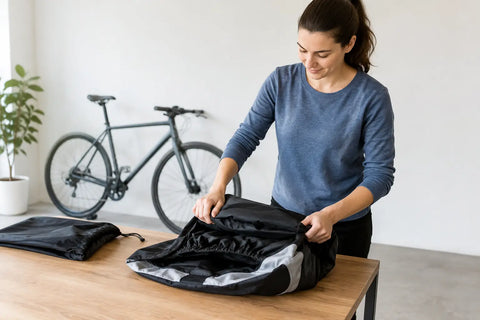
A bike in an apartment is convenient for heading out for a ride whenever the mood strikes. It also means tire marks on the floor, a chain brushing against a wall, and dust accumulating in the entryway. An indoor bike cover offers a simple solution to this problem: it isolates the bike from your interior, while making it easier to store daily.
In a studio, condo, or rental unit, protecting your bike doesn't necessarily mean hiding it in the back of a closet. The right cover allows you to keep it close by without turning the room into a garage. But first, you need to choose a model adapted to how you actually store your bike.
Why cover your bike indoors?
We often think of covers for protecting a bike outdoors, in a garage or on a balcony. However, indoor use is just as useful. After a ride in the rain, on a dusty trail, or on a wet street, tires and drivetrain can bring water, sand, and greasy residue into the apartment.
A cover limits direct contact between the bike and living surfaces. It prevents handlebars from marking a painted wall, pedals from snagging a sofa, or tires from dirtying a light-colored rug. This is particularly appreciated when the bike is parked in a narrow entryway, against a living room wall, or at the foot of a bed.
It also helps preserve the bike itself. Indoors, dust settles on the saddle, brakes, gears, and chain. If your bike goes several weeks without being ridden, a cover provides a simple barrier against everyday dirt, pet hair, and minor bumps during cleaning or moving furniture.
Apartment bike cover: which format depending on your storage?
The right choice depends less on the price than on the location of your bike. Before choosing a cover, observe its usual storage: placed on the floor, suspended, stored upright, or folded. A very protective cover that is difficult to put on is likely to stay in a drawer. Conversely, a light and quick-to-install cover will be used after each trip.
For a bike placed on the floor
This is the most common situation. The bike stays in the entryway, a hallway, a utility room, or a corner of the living room. A full cover then covers the wheels, frame, handlebars, and saddle. It is particularly suitable if the bike is close to walls, furniture, or textiles.
Check the length and height of the model. A city bike, mountain bike, or road bike do not occupy exactly the same volume. Measure your bike from end to end, then compare these dimensions to those of the cover. Allowing a few inches or centimeters of margin makes installation easier, especially with a basket, mudguards, or a luggage rack.
For a bike suspended on the wall or ceiling
A wall mount frees up a lot of space in a small apartment. In this case, the cover must be able to follow the shape of the bike without creating a bulky mass against the wall. A flexible fabric is often more practical than a thick and rigid cover.
Also consider how the cover closes. A zippered opening or a tightening system makes it easier to install when the bike is already hung up. An overly snug cover can be restrictive if you have to remove the bike several times a week.
For a folding bike
Folding bikes are designed for small spaces, but their wheels can still dirty a closet, a car trunk, or the floor near the office. A compact cover is useful for keeping everything clean once the bike is folded.
In this case, look primarily for a cover that is easy to fold and store. It should protect protruding parts, especially pedals and handlebars, without adding too much bulk. If you transport your folding bike in common areas of a building or in an elevator, the cover also prevents friction and tire marks.
The criteria that really make a difference
For apartment use, total impermeability is not always the priority. If the bike remains only indoors, a resistant, washable, and sufficiently covering fabric is generally more useful than a cover designed to withstand long periods in the rain. However, if you often come home with a wet bike or if you also store it on a balcony, a water-repellent material becomes a real advantage.
Size remains the primary criterion. A cover that is too short leaves the wheels exposed, precisely where dirt concentrates. A cover that is too large can drag on the floor, get caught in furniture, and look untidy. The best compromise is a covering cut, with a fit that limits floating fabric.
The closure also matters. An elastic band at the bottom is quick to use, while a strap or drawstring better holds the cover around the bike. For a bike you use every day, choose a simple solution. A minute saved when leaving or returning makes protection much easier to adopt.
Finally, consider maintenance. A bike cover eventually collects dust, splashes, and sometimes tire marks. A washable or easy-to-wipe material is more suitable for regular use. This allows you to protect the apartment without transferring dirt to the cover itself.
Protecting the floor doesn't replace bike maintenance
A cover is excellent protection, but it doesn't make dried mud or excess grease disappear. Before covering the bike, get into the habit of quickly wiping the tires and frame with a cloth. If the chain is very dirty, clean it before bringing the bike into the main room.
This gesture takes little time and extends the cleanliness of the cover. It also reduces the risk of marks on the floor when moving the bike before covering it. For homes with hardwood, carpet, or rugs, this precaution makes a visible difference.
If you ride every day, keep a small dedicated area near the entrance: a cloth, a soft brush, and a folded cover within reach. The goal is not to create a complicated routine, but to prevent bike storage from becoming a chore. An easy-to-grab protection is a protection that really gets used.
A cover adapted to your lifestyle
The choice changes depending on the use. For a bike used on weekends, a full cover can stay in place for several days and effectively protect the bike between rides. For a daily commuter bike, speed of installation is more important. For an electric bike, you also need to consider its larger volume, accessories, and weight when handling.
Families may need several formats. A child's bike, a road bike, and an electric-assist bike do not require the same coverage. Measuring each model avoids buying a cover that is too small or settling for a large, ill-fitting model for all bikes.
At 1001 Housse, the idea is simple: choose a cover that corresponds to a specific object and use. For a bike kept in an apartment, the most useful protection is one that keeps floors, walls, and the bike in good condition without complicating your departures.
Your bike deserves its place in your home without leaving its marks everywhere. A well-sized cover transforms a corner of a room into a clean, discreet, and much more pleasant storage space.