

Which outdoor bench cover should I choose?
of reading
A garden bench left outdoors goes through much more than just a beautiful summer day. Sudden rain, UV rays, pollen, dust, wet leaves, frost, or intense heat can eventually dull the wood, mark the metal, and stain the cushions. So, what outdoor bench cover should you choose to avoid this repetitive maintenance? The right answer primarily depends on the bench's shape, its dimensions, and your region's climate.
A well-chosen cover isn't just for winter. It limits daily wear and tear, keeps the bench ready to use, and reduces the time spent cleaning your patio, deck, or garden area.
Which outdoor bench cover for your model?
Before looking at color or style, observe your bench. A straight bench without armrests doesn't require the same cover as a deep bench with a reclining backrest, wide armrests, or fixed cushions. A cover that's too short leaves the bottom of the furniture exposed to splashes and dirt. Conversely, a cover that's too loose can catch the wind, retain water in its folds, and wear out faster.
For a classic two or three-seater bench, look for a rectangular cover that extends far enough down the legs. For a bench with armrests, choose a cut that is higher on the sides to cover the entire piece without straining the seams. Storage benches, very practical on American patios, often have a deeper lid: measure the actual depth, not just the seat.
If your bench comes with removable cushions, two options are possible. You can remove them and store them indoors to prolong their lifespan, then protect only the frame. If you prefer to leave them in place, the cover must be high and wide enough not to compress them. In this case, a moisture-resistant material becomes even more useful.
Take measurements before ordering
The rule is simple: measure the bench at its widest points. Note its width from one end to the other, its depth from the front of the seat to the backrest, then its height from the ground to the highest point. Add the width of the armrests and the thickness of the cushions if they remain outside.
Note these measurements in inches if your furniture is sold in the United States, or in centimeters if the cover is specified in that format. A small margin is desirable, usually a few inches or centimeters, to easily install the cover. However, don't choose an approximate size. A fitted cover protects better and looks tidier.
The cover material makes all the difference
For outdoor use, a simple decorative fabric is not enough. The cover must form a barrier against common aggressions, while allowing the furniture to breathe. Synthetic materials designed for outdoor use are generally the easiest to live with: they clean quickly, dry properly, and better withstand temperature variations.
A water-repellent cover is well-suited for a bench installed under a porch, pergola, or partially covered balcony. Water beads on the surface and drains more easily. It's a practical solution for light showers, dust, and daily dirt.
For a bench exposed in an open garden, on an open patio or near a swimming pool, opt for a more waterproof cover. It offers enhanced protection against heavy rains and water splashes. Be careful though: waterproof doesn't mean you should enclose the furniture in moisture. A cover without air circulation can promote condensation, especially in humid regions or when the bench is covered immediately after a downpour.
Details also matter. A soft lining helps limit friction on painted or varnished surfaces. Reinforced seams are valuable in windy areas. UV protection is particularly useful in very sunny states, where wood dries out, paints fade, and plastic materials become more fragile.
Waterproof or breathable: do you have to choose?
In most cases, aim for a balance between water resistance and ventilation. A cover that completely blocks rain but retains moisture under the fabric is not ideal in the long run. Side vents, when present, help reduce this risk without directly exposing the bench.
The right choice therefore depends on your environment. In a dry, very hot region, UV resistance and wind resistance may take precedence over maximum impermeability. In a rainy or snowy area, water drainage, fabric strength, and reliable closure become priorities. If the bench is placed under trees, also choose a cover that is easy to wipe clean: resin, bird droppings, and sticky leaves require regular cleaning.
Useful fasteners when the wind picks up
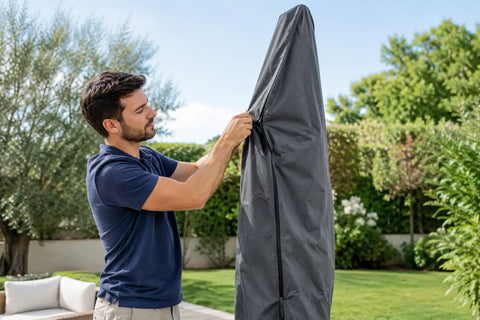
A cover placed without attachments may be sufficient on a sheltered balcony. On an open patio, it risks being lifted by the first gust of wind. Retaining systems prevent this problem and improve protection on the sides of the bench.
Drawstrings allow the cover to be adjusted at the base. Buckle or clip straps attach around the legs and are particularly useful in windy areas. Elastic bands offer quick installation, but must be strong enough to maintain their tension over the seasons.
Do not attach the cover to a still-wet bench. Wait for the surface to dry or wipe it with a cloth. This takes a few minutes and avoids creating a humid environment under the protection. If water accumulates on top after rain, remove it quickly by hand or with a soft brush rather than letting the weight deform the fabric.
Color and shape: practical above all
Dark colors, such as black, anthracite gray, or brown, are often chosen for their discretion and because they better conceal dirt marks. However, they can heat up more under very strong sun. A beige or light gray cover easily blends into a bright setting and absorbs less heat, but it will require more frequent cleaning.
In terms of shape, a simple and fitted cover generally remains the best choice. Ruffles, decorative ties, or very thin fabrics can be pretty, but they are rarely suitable for permanent outdoor protection. For your outdoor bench, opt for a cover designed to withstand the elements, then choose the color that matches your garden furniture.
How to maintain your bench cover?
A protective cover also needs minimal maintenance. Shake off leaves and dust weekly during the warm season. After rain laden with pollen or after a windy spell, a light rinse with clear water may suffice. For more stubborn stains, use a soft sponge, lukewarm water, and mild soap.
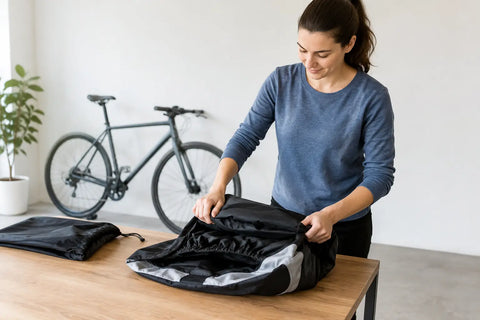
Avoid abrasive products, bleach, and hard brushes, which can weaken the protective coating. Always let the cover dry completely before folding it or putting it back on the bench. During periods when the furniture is used daily, you can roll it up and store it nearby rather than folding it tightly.
At 1001 Housses, the goal remains simple: to find a cover that truly matches your furniture and your use, rather than an approximate protection. Take your measurements, observe your patio's exposure, and choose a suitable fastening. Your bench will remain cleaner, more pleasant to use, and ready to welcome beautiful moments outdoors.